Sardar Vallabhbhai Patel by Balraj Krishna
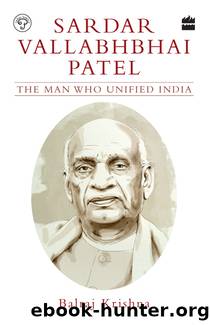
Author:Balraj Krishna [Krishna, Balraj]
Language: eng
Format: epub
Tags: null
ISBN: 9789353024819
Publisher: HarperCollins Publishers India
Published: 2018-08-15T00:00:00+00:00
7
DEMOLISHER OF PRINCELY ORDER
Patel vs. Wellesley
Patelâs unification and consolidation of over 560 princely states, in a country of continental size and diverse people, was epoch-makingâof greater importance than Bismarckâs role in Germany. In India, his creation can be comparable, though in contrast, with Lord Wellesleyâs princely order that laid the foundations of Britainâs Indian Empire. That order, nevertheless, met with its peaceful demise at the hands of Patel. The replacement was most democratic, taking care of the interests of both, the princes and their subjects. Wellesleyâs policy was aggressive imperialism that reduced the once proud princes to mere puppets and sycophants. Patel didnât do that. His integration was a bloodless revolution, in the achievement of which the princes were his equal partners. He was generous to them to a fault, allowing them to live, as before, in their royal palaces and to enjoy handsome privy purses to live happily in the style they were used to. He even offered them opportunities to serve their country in dignified positions.
Wellesley, governor-general of India (1798-1805), built the empire on the basis of two IndiasâBritish India and princely India, each independent of the other, but the latter served as a bulwark against the former. During his seven years in India, Wellesley concluded as many as 100 treaties with Indian princes, making them subservient to British rule under his policy of subsidiary alliancesâan umbrella of âdefensive alliance and mutual guaranteeâ.
India was passing through chaotic times. Princes faced danger from their neighbours, small and big. Wellesley offered them guarantee of protection by stationing British troops within a state, for which payment was made âeither in cash or by alienating a portion of his territory to British controlâ. By such arrangement, the prince was âsecure against his Indian enemies, but also irrevocably attached to his British friends. The Princely fly was firmly enmeshed in the British political web, and any hope of escape was idleâ.1
The princes responded to Wellesleyâs offer in their own interest. To them, his offer of alliances was a beacon of hope, guaranteeing them a continuation of their rule, integrity of their territories and the prospect of their leading a carefree, luxurious life, in many cases licentious, in the seclusion of their palaces. For all this, the princes mortgaged their freedom, and were reduced to powerless stoogesâimpotent potentates.
In 1947, the departing British left the princes forlornâ indeed orphanedâby terminating paramountcy prior to the transfer of power. They feared being swept off by the new winds of a revolutionary change in the wake of the transfer of power. Earlier, the princes had faced threats from their jagirdars and neighbouring princes; now they faced them from their restive subjects, who were determined to wipe off their autocratic ruleâan anachronism in the new climateâin their overwhelming desire to join the mainstream of national life pulsating with the soaring aspirations of a free people. At such a critical moment, Patel came to the princesâ rescue by offering them a new honourable life in a democratic India as equal members of a free nation.
Download
This site does not store any files on its server. We only index and link to content provided by other sites. Please contact the content providers to delete copyright contents if any and email us, we'll remove relevant links or contents immediately.
| Africa | Asia |
| Canadian | Europe |
| Holocaust | Latin America |
| Middle East | United States |
Fanny Burney by Claire Harman(26603)
Empire of the Sikhs by Patwant Singh(23086)
Out of India by Michael Foss(16853)
Leonardo da Vinci by Walter Isaacson(13336)
Small Great Things by Jodi Picoult(7143)
The Six Wives Of Henry VIII (WOMEN IN HISTORY) by Fraser Antonia(5515)
The Wind in My Hair by Masih Alinejad(5095)
A Higher Loyalty: Truth, Lies, and Leadership by James Comey(4964)
The Crown by Robert Lacey(4817)
The Lonely City by Olivia Laing(4802)
Millionaire: The Philanderer, Gambler, and Duelist Who Invented Modern Finance by Janet Gleeson(4478)
The Iron Duke by The Iron Duke(4356)
Papillon (English) by Henri Charrière(4274)
Sticky Fingers by Joe Hagan(4199)
Joan of Arc by Mary Gordon(4110)
Alive: The Story of the Andes Survivors by Piers Paul Read(4033)
Stalin by Stephen Kotkin(3966)
Aleister Crowley: The Biography by Tobias Churton(3640)
Ants Among Elephants by Sujatha Gidla(3467)
